Important Terms and Concepts
Confused about any of the terms used in the website? Curious about learning more? These definitions might be a helpful starting point.
Adivasi
The indigenous communities of India such as the Garo, Munda, Andamanese etc. who are often considered to be outside of the Varna system, lower than Shudras.
Ambedkar
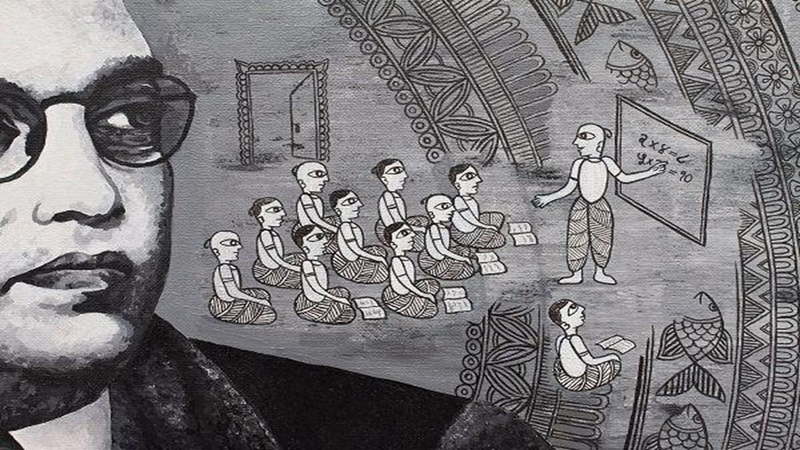
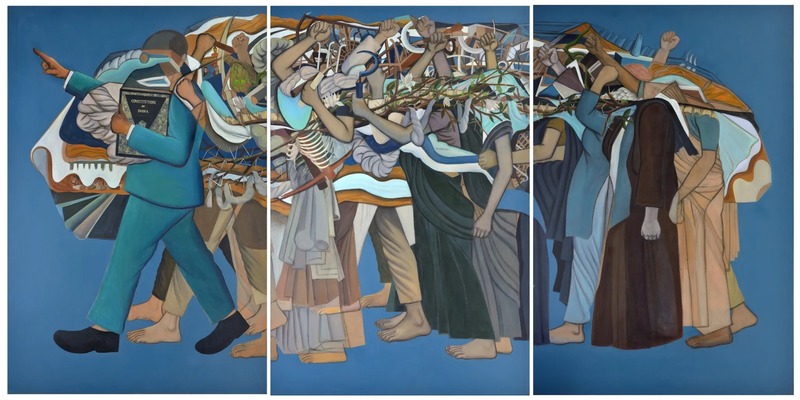
Dr. B.R. Ambedkar was a revolutionary Dalit rights activist, leader, father of the Indian Constitution, and scholar. In pre-independent India and early Independent India, he led the struggle for the recognition of Dalit rights. He is the author of The Annihilation of Caste.
Ambedkarite
Ambedkarite refers to an individual who follows the teachings and ideas of B.R. Ambedkar.
Avarna
Refers to anyone who is considered outside of the varna structure. Includes Dalits and Adivasis.
Bahujan
A Sanskrit word that means “the majority”. In modern contexts, it refers to the combined population of Scheduled Tribes, Scheduled Castes, Other Backward Classes, Muslims, and other minorities, who together make up the majority demographic in India. The Bahujan Samaj Party is a political party in India that was created to represent Bahujans.
Brahmin
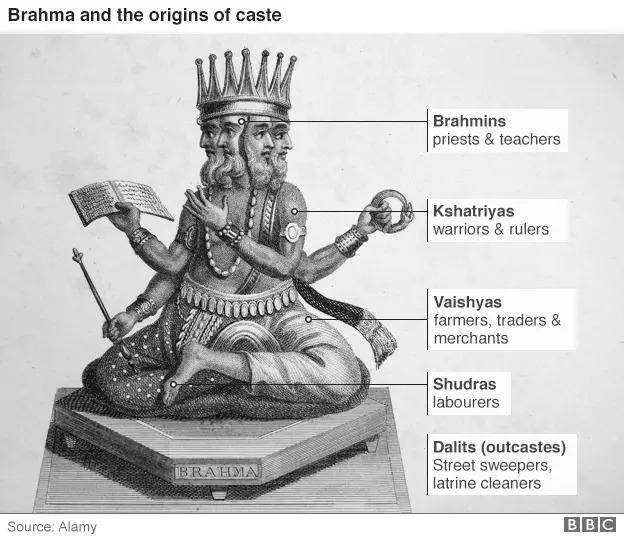
The highest varna in the chatuvarna ladder, includes priests and scholars.
Brahminical Patriarchy
Brahminical patriarchy is a system in which Brahmin men are considered the most powerful, due to their gender and varna. This power decreases for men of each varna below Brahmins. This causes upper caste men to abuse lower caste men, including Dalits. As argued by Sunaina Arya, this abuse causes lower caste men to abuse lower caste women, who have the least amount of power in this system. Although upper caste women hold power due to their varna status, they are also oppressed by the patriarchal system in place, which pushes forth the idea that a woman cannot be considered a true woman until she marries and has children.
Brahminism
Upper-caste Hinduism adhering to the Manusmriti, which outlined a society based in Brahmin supremacy. Brahminism is the belief and its manifestations that those born into the Brahman varna are, by birth, "higher" than all other caste groups.
Buddhism
Buddhism is a religion that was founded on the teachings of Buddha, who lived in India between the sixth and fourth centuries BCE. Buddhists believe that life is a constant cycle, but one can escape from this cycle by reaching enlightenment
Caste
Caste is a social hierarchy wherein people are assigned a social group, or varna, based on birth: brahmans are at the top, then kshatriyas, then vaishyas, then shudras at the bottom. Within each varna there are hundreds of castes, known as jatis. The four varna are derived from Hindu scriptures known as the Vedas, wherein members of each varna are assigned to professions based on notions of "purity" or "pollution," but the social and historical manifestations of caste extend far beyond the varna labor concept. Dalits are not included in the caste hierarchy.
Caste in Abrahamic Religions
Caste in Abrahamic religions are not given any divine right to exist, as they are not sanctified by the religious law/code but in South Asia, where most converts to these religions already possessed a caste from before, caste becomes a social reality in the lived experience of people in these so-called "equal" religions as well.
Class (w/ Distinction from Caste)
An analytical tool used to categorize and study society on the basis of economic status, such as income, wealth, or occupation. Unlike caste, which is a fixed social position inherited at birth, membership within a class is transient, allowing individuals to move between classes over their lifetime. A single class is composed of multiple castes (e.g., Dalits and Brahmins may both belong to a high-income class). While class attributes status to the individual, the caste itself carries status, with individuals collectively making up the caste.
Dalit Christianity
Dalits who convert to Christianity, but continue to be identified and marginalized by their caste. Despite their religious conversion, Dalit Christians continue to face caste-based discrimination both within and outside their religious communities, reflecting the strong influence of caste in South Asian culture. Legally, Dalits who practice non-Vedic religions such as Christianity or Islam are excluded from the category of Scheduled Castes under India’s constitutional framework.
Dalit Feminism
The term has become increasingly popular in contemporary academic and political discourse to advocate for the rights of Dalit women and to better understand the oppression they face. It seeks to examine and address patriarchal structures within lower castes, often referred to as "Dalit patriarchy." Scholar Sunaina Arya argues that the oppression of Dalit women stems primarily from the overarching Brahmanical patriarchy, in other words, the patriarchal system operates under the framework of Brahmanism.
Endogamy
An essential component of caste, endogamy is the practice of marrying within a group. Under the caste system, Brahmans only marry other Brahamans, e.g.
Equality Labs
Founded by Thenmozhi Soundararajan, Equality Labs is a Dalit civil rights organization working to end caste apartheid, gender-based violence, white supremacy, Brahmanisn, Islamophobia, and religious intolerance.
Harijan
Coined by Mahatma Ghandi, a defender of the Chatuvarna system, "harijan" means "children of God" and is a condescending term referring to Dalits. Ghandi was purportedly against caste-based violence, but also believed that Dalits were confined by birth to perpetual servitude -- the term "harijan" communicates Ghandi's position that Dalit servitude serves a sacred purpose.
Hindu American Foundation
The Hindu American Foundation is a Hindu nationalist organization that argues that caste can be separated from Hinduism, which implies that Hinduism is not a discriminatory religion. Furthermore, HAF argues that caste is a deeply confusing and misunderstood system that, when argued against, exposes Hindu Americans to discrimination.
Hinduism
Originally an umbrella term for South Asians (India was called Hindustan under Persian control) of disparate and diverse religious identities/practices, some rooted in Vedic scriptures and the concepts of dharma, karma, and varna. Became a legal term for any person in India who did not practice Christianity or Islam under British colonial rule. Considered one of the Vedic religions.
Hindutva
A right-wing, ethno-nationalist ideology that seeks to redefine secularism in India’s constitution through the Hindu framework. Its efforts to reconstruct India into an ethno-religious state is intended to prioritize the identity and interests of the country’s majority Hindu population. The term Hindutva is often used interchangeably with Hindu nationalism, and is used to promote Hindu cultural dominance in the political, social, and legal structures of Indian society.
Intersectionality
It is the study of overlapping identities and oppressive structures. First coined by Kimberle Crenshaw in 1989. Menon criticizes intersectionality and how it's used to analyze caste: she argues that while helpful language in the United States legal system, intersectionality assumes that identities are fixed things -- Menon argues that a framework accepting the instability of identity might be more useful.
Islam & The Pasmanda Movement
Islam is an Abrahamic religion that follows the teachings of the Qur’an. Followers of Islam believe in a singular god, along with the prophet Muhammad. The Pasmanda Movement is a contemporary term used by lower and backwards caste individuals to identify themselves within Islam. This movement aims at preventing caste-based discrimination within the religion.
Jainism
A Vedic religion that teaches the path to enlightenment (Moksha) is achieved through reducing violence against all living things - including plants and animals - as much as possible. Jains believe in reincarnation, the idea that the cycle of birth, death and rebirth is determined by one’s karma.
Jati
Where Varna is the theoretical scheme behind caste, jati is the "social reality" of caste (Viswanath). Jati are endogamous groups with local reach, and while each jati is associated with a varna, they are organized according to material wealth and specific professions. For example, while Dalits are excluded from the varna system, a hierarchy of jatis still exists within Dalit communities.
Jotirao Phule
A prominent Shudra rights activist from the 19th century. Wrote "Gulamgiri" or Slavery, to illustrate the condition of the Shudras and who he called "Ati" Shudras
Karma
Karma is the idea that actions in a person’s current life will either reward them with a better next life, or a worse next life. This concept is used to justify caste, since those of upper castes argue that they are in a place of power due to maintaining a good past life.
Kshatriya
The Kshatriya varna 2nd highest caste in the chaturvarna ladder, comprises warriors, soldiers and kings
Manual Scavenging
The occupation of manually cleaning out sewers and septic tanks to prevent blockages. In the caste system, this occupation is confined to the Dalit community.
Manusmriti
The Hindu "Law Code" written by Manu, a prominent Hindu "legal" scholar. Formed the basis of what the Brahmin Varna in Hinduism sought from the other Varnas. Highly casteist, misogynistic, anti-indigenous and racist.
Orientalism
Orientalism is a Western perspective of the East, which is seen as ‘other’. Due to the lack of specificity in defining what the East consists of, the Orient as an idea and a place is always changing. This constructed binary reduces the studies of Eastern societies into a one dimensional entity; however, in reality, they are infinitely complex. This system of narrowing the view of the middle and far east perpetuates the idea that this area is some sort of other that must be fixed, which allows for colonization and white supremacy to occur. Therefore, as pointed out by Edward Said, Orientalism is not a real study, but is rather a way of continuing rhetoric of white superiority.
Other Backward Classes (OBC)
Other Backward Class (OBC) is the legal term for groups that the Indian government deems socially, economically, or educationally disadvantaged. Under the schedule system, 27% of government jobs are reserved for members of OBCs, which can include Shudra communities and other socially disadvantaged groups not included as SCs or STs.
Out-Caste
Those considered to be outside the Chaturvarna system.
Periyar
Periyar was a politician and activist who started the Self-Respect Movement in order to argue against religion. Periyar believed that women should receive an education, and argued for equality between men and women. He also stood in opposition to the ideas of Gandhi, largely due to his anti-religion and anti-brahminism ideas.
Power
Power as understood by Foucault is a concept present in all relationships - interpersonal, between institutions and between institutions and individuals, and emanates everywhere. It defines the norms and customs of what is and is not possible indirectly and separate from violence.
Race (w/ Distinction from Caste)
The grouping of people based on physical characteristics. Race and caste hierarchies are distinct from one another: as Oliver Cox argues, anti-Black racial hierarchy (sp. in the United States) is deeply capitalistic, existing to justify labor exploitation (first as slavery and now as systemic discrimination), whereas caste transcends any economic system. While colorism and race interact with caste, rigid social castes are not assigned based on physical characteristics -- they are ordained at birth based on lineage.
Religion
Developed in the nineteenth century to group together different rituals and practices, the term “religion” studies what people do, how they behave, and why they do so. This definition differs from theology, which studies and interprets scripture. The definition of religion is constantly changing in order to include and exclude ever changing views of what religion consists of. Therefore, religion is an abstract entity that is not grounded in reality because it must constantly adjust in order to include natural human states of being. With this understanding, everything that people do is religion, therefore nothing is religion. This means that religion does not exist.
Sadhana
The Sadhana Coalition of Progressive Hindus is a Hindu organization working to dismantle the practices and beliefs structured around caste. Despite this organization's efforts to rid the caste system, they continue to reference the Brahman and Vedic texts, centering their advocacy on the restructuring and reclaiming of the Hindu religion, limiting their capacity to address Dalit voices and forward Ambedkar's vision of a casteless future.
Savarna
The term used to describe the more privileged, upper-caste communities. It refers to the three highest Varnas: Brahman, Kshatriya, and Vaishya.
Scheduled Caste (SC)
Scheduled Caste (SC) is the legal term designated to Dalits, in order to prevent caste discrimination in the workforce, educational institutions, and other areas. This system is similar to affirmative action in the United States. However, in many cases the designation of Scheduled Caste works against Dalits, exposing them to discrimination rather than preventing discrimination from occurring.
Scheduled Tribe (ST)
Scheduled Tribe is the legal term used in the Indian constitution to refer to the Adivasi (indigenous) people. Holding ST status allows members to receive certain protections and benefits, such as political representation as well as job and educational opportunities.
Sikhism
A Vedic religion founded by Guru Nanak in the 15th Century. Sikhs are monotheistic and do not believe in the concept of varna. Equality under God is a central tenet of Sikhism, but caste and jatis still exist in Sikh communities.
Shudra
Shudra is the fourth varna, made up of labourers and servants.
Thenmozhi Soundararajan
A prominent American Dalit activist who founded Equality Labs to fight against casteist oppression with a focus on the diaspora particularly in America
Twice-Born
Twice-born is a term to describe Brahmins, Kshatriyas, Vaishyas. This term originates from a ceremony in which young boys are spiritually born again. Those considered as twice-born are seen as superior to individuals that are from lower castes, and do not participate in this ceremony.
Untouchability
Abolished legally in 1950 but still prevalent today, untouchability is a systemic form of violence and discrimination against Dalits, once known as "untouchables." Examples include preventing Dalits access to communal water sources, exluding Dalits from schools/temples/public events, public humiliation of Dalits, and licit "punishment" (rape, beating, etc.) of Dalits.
Upper/Lower Caste
Upper caste is a term to describe Brahmans, Kshatriyas, and Vaishyas. However, Vaishyas are not always referred to as upper caste. These varnas constitute the top part of the caste hierarchy. Lower caste is a term used to describe Shudras, Dalits, Adivasis, and other groups that are considered to be outside of the caste system. These castes often face discrimination by upper castes, due to the idea that those of upper caste status are pure and superior to those of lower castes.
Vaishya
The Vaishya varna is the third varna, referred to as the farmers and merchants of the caste system.
Varna
A system of social stratification in the Vedic religion that divides people into four categories: Brahmans, Kshatriyas, Vaishyas, and Shudras.
Vedic Religions
Religion(s) following the sanctity of the Vedas, a set of religious scriptures originating in the Indus River Valley.
Yashika Dutt
Author of the acclaimed memoir "Coming Out as Dalit," Dutt is a Dalit writer, journalist, and activist. Her work underscores the importance of education as a facet of Dalit resistance and reckons with casteist discrimination both in India and the South Asian diaspora.