Anti-Caste Art
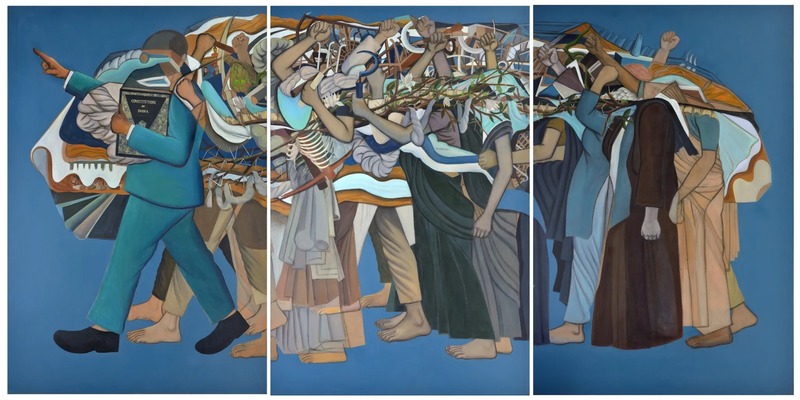
Vikrant Bhise, "Quest of Existence of Being" (2023), acrylic on canvas, 72 x 120 inches (all images courtesy the artist and Anant Art Gallery)
Dalit anti-caste artworks, which include music, poetry, film, and visual art, are powerful expressions of resistance and reclamation that challenge the deep-rooted caste system in South Asia. From the defiant beats of Dappu drums and Gaana music by The Casteless Collective to Savitribai Phule’s transformative poetry advocating education and equality, these works turn pain into resilience. Films like India Untouched and Kakkoos expose caste-based discrimination and its ongoing injustices, sparking critical conversations despite backlash. Exhibitions like Dalit Dreamlands envision a future of anti-caste solidarity, centering marginalized voices, including queer and trans perspectives. Together, these creations transcend art, inspiring resistance, dialogue, and hope for an equitable future.
MUSIC
India Untouched: Featuring music and dance by Dalit folk artists
Dalit anti-caste artworks include a range of musical expressions, such as the traditional rhythms of the Dappu drum, which feature prominently in India Untouched. This documentary highlights the music and dance of Dalit folk artists, showcasing their cultural heritage and resilience. Watch a clip of the performance here.
Dalit rap/music (The Casteless Collective)


Image of The Casteless Collective band, from Indian Cultural Forum, 2020
Take a listen to “Jaibhim* Anthem” by The Casteless Collective
*The repeated chant “Jai Bhim! Jai Bhim!” honors Dr. B.R. Ambedkar, a social reformer and Dalit icon.
The Casteless Collective is a Chennai-based band that brings together marginalized Dalit musicians to create powerful music. Their work challenges caste-based oppression in India by blending traditional Gaana, a Tamil folk music genre historically associated with funerals and emotional pain, with modern styles like hip-hop to produce a genre-defying sound.
Gaana Music: Traditionally played at funerals, Gaana is deeply rooted in emotional expression. According to Tenma, a co-founder of the band, "Gaana music comes from a lot of emotional pain... It’s not academic but based on percussion and feeling." Vocalist Isaivani adds, "Folk music is for body pain, but Gaana is for emotional pain."
The Instruments:
Traditional instruments like the katte molom and satti are central to Gaana and typically used in funerals. However, in The Casteless Collective's hands, they spark energy and make people dance. These instruments stand in contrast to caste-restricted ones like the mridangam or tabla, making their music inclusive and revolutionary.
Insights from the Artists:
-
Tenma (co-founder):
“Gaana music comes from a lot of emotional pain. Gaana artists have been overexploited for decades. It’s not academic—it’s percussion, movement, and raw feeling.”
He compares Gaana to the blues, calling it “the blues of the Tamil music scene.” -
Isaivani:
“Folk music is for body pain. Gaana is for emotional pain."
To learn more about The Casteless Collective, check out this short documentary!
This is A Music: Reclaiming an Untouchable Drum
Directed by Zoe C. Sherinian (2011), this powerful ethnomusicological documentary explores the transformative journey of Dalit parai frame drummers from a village near Paramagudi, Tamil Nadu.
In Hinduism, the parai drum is stigmatized as "polluted" because of its association with funerals, reflecting the entrenched caste-based discrimination against Dalits. Through the lens of music, the film delves into how these drummers reclaim their art and identity, challenging societal perceptions of "untouchability."
As the documentary unfolds, it captures how the act of drumming empowers the artists, reshaping their self-worth and psychological resilience while navigating the harsh realities of caste oppression.

Stills from Reclaiming an Untouchable Drum
POETRY
Savitribai Phule
Savitribai Phule (1831–1897) was a pioneer in social reform, breaking barriers as one of the first female educators in India. Alongside her husband, Jyotirao Phule, she established the first school for girls in 1848, later founding 18 more schools. Their efforts challenged caste and gender inequality at great personal cost—they were evicted from their home and faced relentless societal opposition.
Phule’s collection, Kavyaphule (1854), is a testament to her poetic genius and unwavering commitment to social justice.
In recognition of her monumental contributions, Pune University was renamed Savitribai Phule Pune University on August 9, 2024.
Discover more of her inspiring poetry:
Read Savitribai Phule’s poems here

Picture of Savitribai and Jyotirao Phule at Phulewada, Pune
https://commons.wikimedia.org/wiki/File:Savitribai_Phule_Jyotirao_Phule_Phulewada_Pune.tif
Poetry by Savitribai Phule
The Plight of the Shudras
"Haunted by ‘The Gods on Earth’,
For two thousand years,
The perpetual service of the Brahmins,
Became the plight of the Shudras.
... Education is the path,
For the Shudras to walk,
For education grants humanity,
Freeing one from an animal-like existence.”
These verses capture her call for empowerment through education, especially for marginalized communities.
FILM

India Untouched: Stories of a People Apart (2007)
Directed by Stalin K, India Untouched is a powerful documentary that takes an in-depth look at the caste system in India through a series of personal interviews across a diverse spectrum of society. Over four years, Stalin K traveled through India, exploring how caste-based oppression continues to influence everyday life. The film highlights how caste manifests not only in social interactions but also in the identities people form—both self-perceived and imposed by society. The documentary explores the impact of caste on Dalits within Hindu, Sikh, Christian, and Muslim communities, shedding light on a persistent and pervasive issue that continues to shape social dynamics in South Asia.
Watch India Untouched here.

Kakkoos “Toilet” (2017)
Directed by Divya Bharathi, Kakkoos exposes the brutal reality of manual scavenging in India, a practice that, despite being officially outlawed, is still prevalent and deeply intertwined with the caste system. The film reveals how the dehumanization of Dalit individuals justifies the dangerous and degrading work of manual scavenging. Kakkoos sparked significant political controversy, with Bharathi facing numerous threats and even arrest after its release. Despite these challenges, the documentary gained significant attention, especially in academic circles outside Tamil Nadu, where it was screened in universities.
Watch Kakkoos here.

Ajeeb Dastaans “Strange Stories” (2021)
Ajeeb Dastaans is a series of four short films that delve into complex issues in relationships, exploring uncomfortable emotions and tensions beneath the surface. One of the standout stories, Geeli Pucchi (dir. Neeraj Ghaywan), examines caste, power, privilege, sexuality, and queerness. The narrative follows the relationship between Bharti Mandal, a Dalit woman, and Priya Sharma, a Brahmin woman, offering a nuanced portrayal of these characters. Neither woman is portrayed as morally superior, allowing for a more empathetic exploration of their experiences and struggles.
DALIT DREAMLANDS
Dalit Dreamlands is a powerful multimedia exhibition that amplifies the voices of artists from Dalit, Adivasi, Bahujan, Afro-Indian, Indo-Fijian, Indo-Caribbean, and Muslim communities. The exhibition creates a safe, celebratory space for marginalized and caste-oppressed South Asians to showcase their artistic expressions. Through a dynamic blend of performance, music, fashion, film, paintings, and visuals, Dalit Dreamlands explores queer and trans caste futurisms, imagining a world beyond the constraints of caste and oppression. The event is curated by Manu Kaur (they/them) and supported by AAWAA’s Emerging Curator’s Program, offering a platform for underrepresented voices to envision a more inclusive, anti-caste future.
Explore more here:

